Pain, Suffering, and the Art of Living Well
Introduction: Pain as the Signature of Physical Life
Pain is one of those topics that every human being understands intuitively, yet struggles endlessly to make sense of intellectually. We try to avoid it, fight it, deny it, medicate it, spiritualize it, or explain it away, but no matter how sophisticated our strategies become, pain remains a constant companion of physical life. At some point, each of us realizes - sometimes gently, sometimes violently - that life in a physical body is characterized by certain degrees of discomfort. In Buddhism, this is commonly called suffering. And while the word itself carries heavy emotional weight, its meaning is often misunderstood.
Physical life, by its very nature, includes friction, resistance, limitation, and decay. There is nothing abnormal about this. There is nothing wrong with it. It is not a mistake, nor a punishment, nor a flaw in the design of reality. It is simply what it means to exist in a physical world governed by space, time, and causality. And because these laws are inherent to physical reality, there is ultimately nothing we can do to abolish pain entirely. What we can do, however, is decide how we are going to relate to it, how we are going to cope with it, and how we are going to transform it into something meaningful.
A helpful way to look at this is to think about the seasons. Seasons are there. They come and go. Winter turns into spring, spring into summer, summer into autumn, and autumn back into winter. We cannot change this cycle. No amount of wishing, protesting, or complaining will abolish winter or freeze summer forever. But what we can change is how we react to the seasons. We can dress differently. We can adapt our activities. We can learn to appreciate what each season offers, even if some are more comfortable than others. Pain in life works in much the same way.
Everything in physical reality is transient. Everything is born, grows, declines, and dies. This is not pessimism; it is realism. This is the basic observation that lies at the heart of Buddhism and many other wisdom traditions. Once we understand and accept this process, we can stop fighting reality itself and start making the best out of the limited, precious time we are given. Acceptance, in this sense, is not resignation. It is clarity. And clarity is the foundation of a fulfilled life.
Transience, Manifestation, and the Laws of Birth and Death
Many religious and philosophical traditions share a remarkably similar intuition: that the Absolute - whether called God, Brahman, Tao, or simply Truth - exists beyond space and time. And if something is beyond space and time, it is by definition beyond physical reality, because space and time are the defining characteristics of the physical world. What does not obey space and time is unmanifested. And what is unmanifested is, therefore, beyond birth and death.
The moment something becomes manifested, however, the rules change. Once you enter physical reality, you must yield to the laws that govern it. You are born. You grow. You age. You decay. And eventually, you die. This is not cruel. It is not unjust. It is simply natural. Expecting physical life to be free from birth and death is like expecting fire not to burn or water not to flow downhill. The problem is not reality. The problem is our refusal to accept what reality is.
Seen from this perspective, suffering becomes understandable. It is not some mysterious curse hanging over human existence. It is a direct consequence of impermanence interacting with desire, attachment, and ignorance. We want things to stay the same, but they change. We want pleasure to last forever, but it fades. We want youth, health, and security, but time relentlessly moves forward. This tension between how things are and how we want them to be is where suffering is born.
And yet, this does not mean that life is pointless, bleak, or devoid of joy. On the contrary. Understanding the conditions under which suffering arises allows us to distinguish between different kinds of suffering - and this distinction is crucial if we want to understand the purpose of life and what it means to live happily and meaningfully.
Necessary Suffering and Unnecessary Suffering: A Crucial Distinction
Not all suffering is the same. This may sound obvious, but it is a distinction that is surprisingly rarely made with sufficient clarity. There is suffering that is inherent to physical existence, and there is suffering that is created by ignorance, malice, and poor decisions. Confusing these two leads either to nihilism (“everything is suffering, so nothing matters”) or to naive optimism (“suffering shouldn’t exist at all, so reality is wrong”). Both positions miss the point.
Necessary suffering is the kind of discomfort that naturally arises from growth, change, and learning. It is the friction that occurs when we move beyond our comfort zones. It is the unease of the unfamiliar, the strain of effort, the vulnerability of exposure, and the pain of letting go of old habits and identities. This kind of suffering is not only unavoidable - it is essential. Without it, development would be impossible.
Unnecessary suffering, on the other hand, includes the extreme, pathological forms of pain that plague human history and continue to do so today: murder, war, genocide, discrimination, hatred, cruelty, and maliciousness. These are the things we objectively term as evil. They are not required for growth. They do not contribute to the development of humanity. On the contrary, they represent obstacles, brakes, and regressions. They arise from ignorance, fear, greed, and a failure to understand ourselves and others.
While even these forms of suffering may lead to learning in retrospect - often at an unbearable cost - they are not inherent necessities of life or development. They aim at nothing apart from reaping bad consequences from bad decisions. Understanding this difference matters deeply, because it changes how we approach ethics, responsibility, and the meaning of progress.
Buddhism, Suffering, and the Noble Eightfold Path
This is where Buddhism offers profound insight. When the Buddha said that “all life is suffering,” he was not making a nihilistic or depressive claim. He was stating a diagnostic truth: that conditioned existence is marked by dukkha - a term that includes discomfort, dissatisfaction, impermanence, and existential unease. But Buddhism does not stop there. In fact, the very next teaching is that suffering has a cause, that it can be reduced, and that there is a path leading to its cessation.
This path is known as the Noble Eightfold Path, and it represents a practical guide for living wisely within the constraints of physical reality. It does not promise the abolition of all pain, but it does offer a way to eliminate unnecessary suffering. Right understanding, right intention, right speech, right action, right livelihood, right effort, right mindfulness, and right concentration - these are not abstract ideals. They are concrete principles for aligning our lives with reality as it actually is.
When we live in accordance with these principles, life can and should be filled with joy, meaning, and fulfillment. There is no contradiction between acknowledging that life includes suffering and affirming that life can be deeply satisfying. The contradiction only arises when we fail to understand what kind of suffering we are talking about.
Life as Psychological Evolution
From a biological perspective, evolution has already brought us remarkably far. Our bodies are complex, adaptive, and resilient. But at a certain point, biological evolution transitions into psychological evolution. The central challenge of human life today is no longer merely survival, but the development of emotions, feelings, thoughts, values, and meaning.
We are in this physical life to develop - physically, emotionally, and intellectually. And while physical development follows relatively straightforward biological rules, emotional and intellectual development require conscious participation. They require experience. They require engagement with the world. And most importantly, they require friction.
You do not develop by remaining static. You develop by manifesting and expressing new capabilities in the real world. You develop by testing yourself, by making mistakes, by encountering resistance, and by adjusting your behavior accordingly. This constant interaction with the outside world inevitably produces discomfort. But this discomfort is not a sign that something has gone wrong. It is a sign that something is happening.
Change always brings a certain degree of pain, because change means leaving behind what is familiar. Habits dissolve. Identities shift. Expectations are challenged. But without this process, there would be no learning, no growth, and no evolution. Necessary suffering is the price of becoming more than you were yesterday.
The Playground of Life: Learning Through Challenge
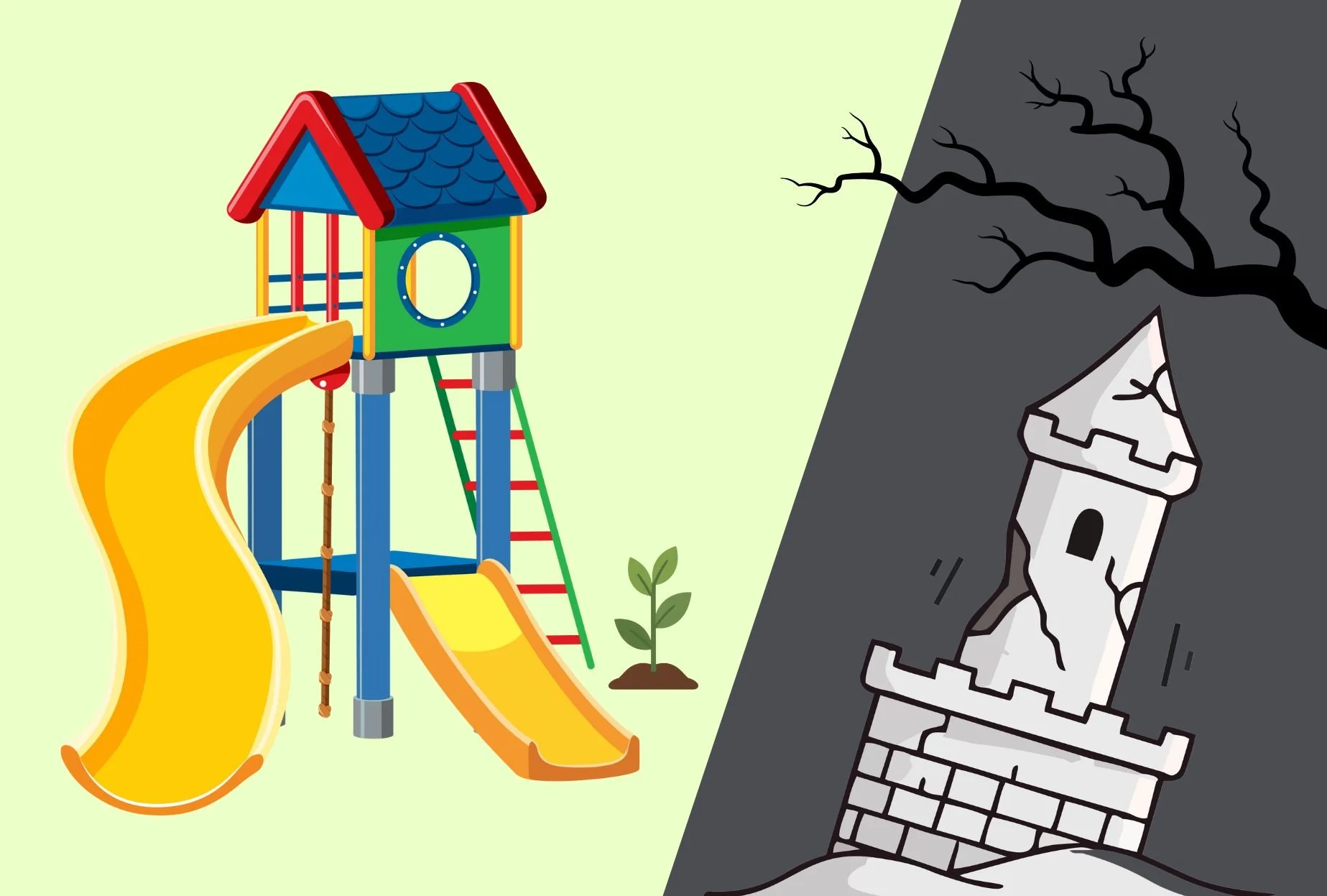
A simple but powerful metaphor helps illustrate this idea: the playground. Children go to playgrounds because they love to move, explore, and test their capabilities. They climb, crawl, slide, swing, rotate, and jump. They actively seek out challenges, because challenge is fun when it is appropriate to one’s abilities.
The obstacles on a playground represent positive, necessary suffering. They demand effort. They require coordination. They occasionally result in small falls, scrapes, or frustrations. But these experiences are precisely what allow children to learn about their bodies, their limits, and their potential. They are not traumatized by this kind of discomfort; they are energized by it.
Now imagine a playground designed differently. Imagine facilities so difficult and dangerous that children constantly break their legs, fall from great heights, and seriously risk their health and lives just by trying to play. This would no longer be a playground. It would be a torture chamber. That kind of suffering would be unnecessary and destructive.
Life works in exactly the same way. We need challenges that stretch us without destroying us. We need resistance that teaches us without crushing us. Between complete lazy comfort and complete dread lies a golden middle ground - the optimal zone for learning, development, enjoyment, and fulfillment.
The Gym of Existence: Strength Through Resistance
A second metaphor makes this even clearer: the gym. People go to the gym to develop strength, health, and vitality. How does this work? By challenging muscles against resistance. Muscles grow precisely because they are stressed. After training, you may feel sore. You may feel tired. But this pain is meaningful. You recognize it as a good kind of suffering. You accept it in the name of a greater good.
Now imagine a gym where you are forced to lift weights far beyond your capacity. The dumbbells are too heavy. The bars are impossible to control. Instead of building strength, you tear muscles, damage joints, or break bones. The entire process becomes pointless and dangerous. This is not training. This is harm.
Again, the lesson is obvious: the right amount of suffering leads to growth. Too little leads to stagnation. Too much leads to destruction. Wisdom lies in finding and maintaining this balance - not just in the gym, but in every area of life.
Meaning, Responsibility, and the Art of Coping
Once we understand that pain is an inherent feature of physical reality, the question of life shifts. The question is no longer “How do I eliminate all suffering?” but “How do I relate to suffering in a way that leads to growth, meaning, and compassion?”
This is where responsibility enters the picture. While we cannot control everything that happens to us, we can influence how we respond. We can reduce unnecessary suffering - both in our own lives and in the lives of others - by acting wisely, ethically, and consciously. We can choose not to add hatred on top of pain, not to add resentment on top of loss, not to add cruelty on top of fear.
The Noble Eightfold Path can be seen as a sophisticated framework for doing exactly that. It teaches us how to live skillfully within an imperfect world, how to accept the seasons of life without being destroyed by them, and how to cultivate inner freedom even when outer conditions are difficult.
Conclusion: Choosing What Kind of Suffering We Allow
Pain is not the enemy. Unconsciousness is. When we fail to understand the nature of reality, pain turns into suffering in the deepest and most destructive sense of the word. But when we see clearly - when we recognize impermanence, accept the laws of physical existence, and distinguish carefully between necessary and unnecessary suffering - life opens up in profound and practical ways.
Everything is transient. Everything is born, grows, declines, and dies. This is not a tragedy; it is the basic rhythm of existence. Necessary suffering arises directly from this rhythm. It is the discomfort of change, effort, learning, aging, and letting go. This kind of suffering cannot be abolished without abolishing physical life itself. And it does not need to be abolished. When understood correctly, it becomes meaningful. It becomes the very engine of growth, wisdom, creativity, and maturation.
Unnecessary suffering, however, stands in a completely different category. It is not woven into the fabric of reality. It is woven into the fabric of human ignorance. War, hatred, cruelty, discrimination, exploitation, and maliciousness are not unavoidable expressions of physical existence. They are the results of fear-driven thoughts, unexamined emotions, and poor collective decisions. And because they are created by human minds and human systems, they can also be reduced - and ultimately abolished - by human minds and human systems.
This is the crucial point: while we cannot eliminate pain, we can eliminate vast amounts of suffering. While we cannot stop the seasons from changing, we can stop building societies that turn winter into starvation and summer into fire. Necessary suffering humbles us and teaches us. Unnecessary suffering degrades us and holds us back. Confusing the two leads either to resignation or to cruelty. Distinguishing between them opens the door to responsibility.
To live well, individually and collectively, is not to wage war against reality, but to align with it intelligently. It is to accept the playground while removing the lethal traps. It is to accept the gym while refusing weights that shatter bones instead of building strength. A wise society does not promise a life without pain - but it commits itself to removing suffering that serves no purpose, teaches no lesson, and destroys more than it reveals.
When this distinction becomes clear, the purpose of life becomes clearer as well. We are here to grow, to learn, to develop emotionally and intellectually, and to help one another do the same. Necessary suffering will always accompany this process. Unnecessary suffering does not have to. Its continued existence is not fate; it is a choice.
And that choice is in our hands.
To live wisely, then, is to embrace the challenges that life inevitably brings while refusing to normalize cruelty, violence, and despair. It is to treat existence as a playground designed for learning, not as a battlefield designed for domination. When we do this - when we consciously accept necessary suffering and consciously work to abolish the unnecessary - life, even in an impermanent world, becomes not only bearable, but deeply meaningful, joyful, and worthy of our full participation.
